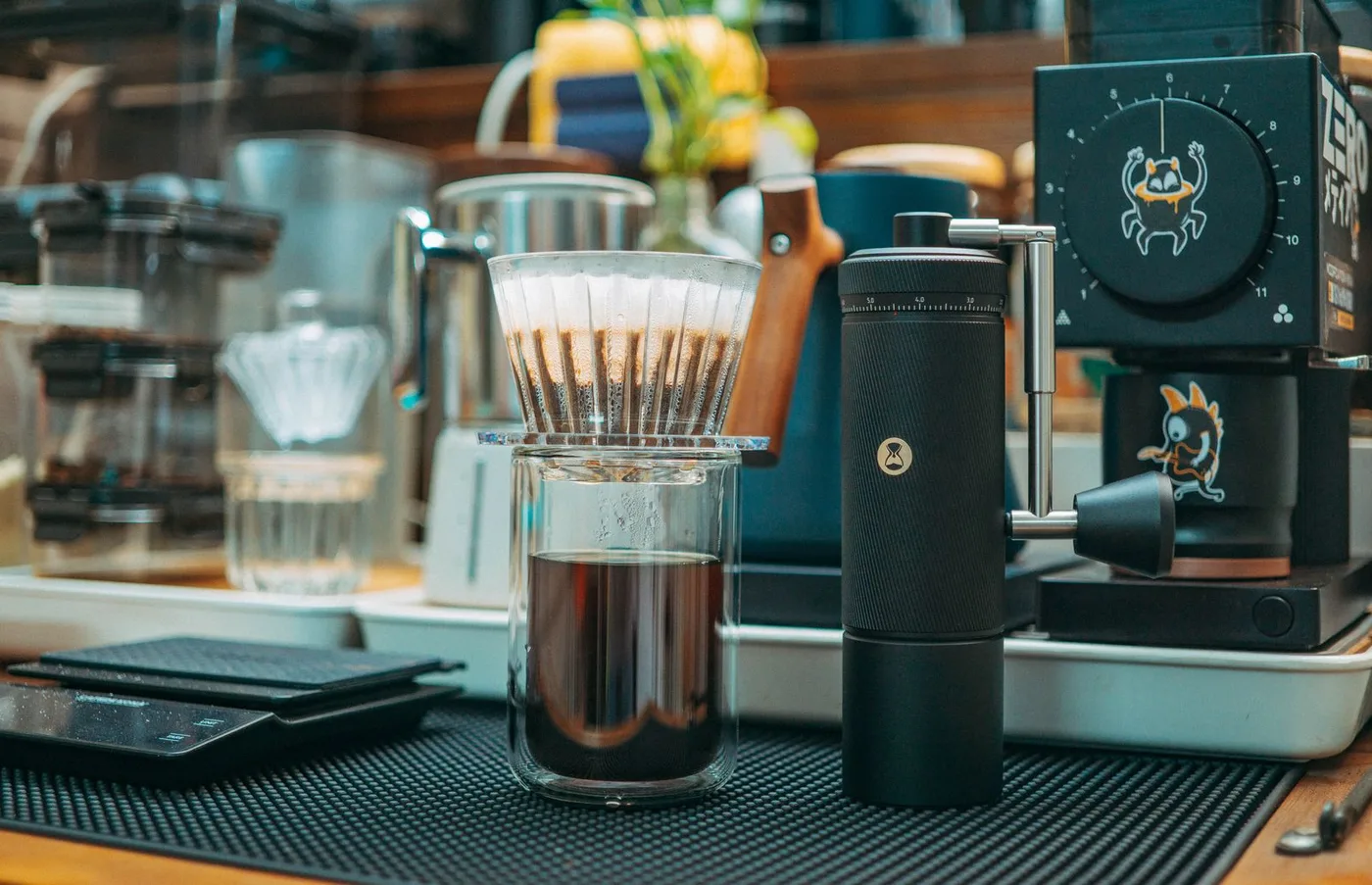
A grinder purchase often starts with a vague promise of better coffee. A more useful starting point is the brewer on the counter and the number of drinks made before work. Grinding one pour-over by hand is a different task from preparing a family carafe or adjusting espresso for a new bag of beans. A machine that solves one task can make the others slower.
The following framework separates those jobs and uses two current electric grinders as concrete examples. Manufacturer specifications were checked November 6, 2026. We have not independently measured grind distribution, retention, noise, or flavor, and the recommendations describe workflow fit rather than tested performance rankings.
For daily filter coffee, prioritize repeatable adjustment and a dose routine you can maintain. For a non-pressurized espresso basket, require genuinely fine adjustment. A manual grinder saves outlet space but asks for repeated physical work, especially for multiple servings.
Identify the brewer before counting the settings
Write down the brewing method you use at least several days a week. An automatic drip machine, a pour-over brewer, and a French press all benefit from repeatable adjustment, but they do not demand the same fine control as dialing in a non-pressurized espresso basket. Buying for an imagined future espresso machine can add cost without improving today's breakfast routine.
Do not treat the smallest advertised grind size as the whole espresso requirement. The useful question is whether adjacent adjustments let you tune a shot without jumping past the result you want. A grinder described as fine enough for espresso may still offer an inconvenient adjustment range for your basket, beans, and recipe. Check the manufacturer's intended application and the brewer's requirements together.
A pressurized espresso basket changes the buying question again. Read the machine's instructions before assuming you need the same adjustment system as an unpressurized setup. If coffee is still uneven after a change, examine dose, water, and brewing technique before concluding that only a more expensive grinder can fix it.
Swipe left or right to compare all columns ↔
| Design | Useful routine | Selection priority | Reason to skip |
|---|---|---|---|
| Manual burr grinder | One modest batch with no need for an outlet | Comfortable handle, usable grounds capacity, repeatable adjustment | Repeated cranking is impractical for several people or uncomfortable for your hands |
| Electric burr grinder for everyday filter coffee | Daily drip, pour-over, or press batches | Simple repeatable setting and manageable dose transfer | Fine espresso adjustment is your main requirement but is not established |
| Electric grinder with an espresso adjustment range | A non-pressurized espresso machine used regularly | Small adjustment steps where espresso is dialed in | You only make a forgiving filter batch and will not use the added control |
Measure the dose and the work you are willing to repeat
Weigh the dry coffee used for a normal batch. For example, a household recipe using 30 g each morning needs that working dose, not a huge hopper simply because the bean bag is large. If two people brew separately, count two dosing and cleanup cycles. Hopper size and grounds-bin size describe storage limits; they do not tell you how convenient a single small serving will be.
A timer controls duration, not coffee mass. Changing beans, grind setting, or hopper conditions can change how much coffee comes out in a given time. If repeatable grams matter, weigh the output or use a documented grind-by-weight system. Do not assume a remembered timer setting eliminates the need to check the dose.
For a hand grinder, consider the work when you are rushed rather than when browsing on a quiet weekend. Fine grinding and multiple servings can make the physical task less appealing. If possible, handle a display sample and inspect how the body is gripped and the catch cup removed. A compact grinder has little value if you avoid using it because the required motion is uncomfortable.
Use these pass-or-fail checks before comparing prices
Measure the available counter rectangle and the clearance above it. Add room to lift the hopper lid and remove the grounds bin. A grinder that fits on paper may still need to be dragged from under a cabinet every morning. Check where the cord runs and where you will place a scale without balancing it at the counter edge.
Choose a realistic cleaning method. Ask whether the upper burr can be removed, whether the chute is accessible, and how settings or alignment are restored afterward. These are ownership questions, not signs that a grinder has poor performance. Grounds and oils need a maintenance plan regardless of the exterior finish.
If you regularly alternate regular and decaf, record that as a requirement. A large hopper of beans is convenient for one household blend but awkward when switching often. Single dosing can simplify the input, yet it does not establish that no grounds remain inside. Without measured retention data, allow for possible carryover rather than promising a completely clean transition.
Swipe left or right to compare all columns ↔
| Check | Your concrete requirement | Do not substitute |
|---|---|---|
| Brew compatibility | An adjustment range intended for your brewer | A large setting count with no explanation of its useful range |
| Batch size | Your weighed dose fits the working container | A marketing cup count without grams |
| Kitchen fit | Measured footprint plus lid and bin removal clearance | Body dimensions alone |
| Dose control | A weighed output or an acceptable manual checking routine | A timer treated as a mass sensor |
| Maintenance | You can access and clean parts as instructed | An assumption that stainless burrs never need attention |
| Longer ownership | An identifiable support and replacement-parts path | An unsupported lifetime-durability promise |
Two electric shortlists, with different reasons to buy
OXO's Conical Burr Coffee Grinder, SKU 8717000, lists 15 numbered settings with intermediate adjustments and a timer that remembers its last setting. Its hopper holds 12 oz of beans. Our recommendation is to consider this workflow first for a household making regular filter batches that values uncomplicated timed operation. The timer still needs a dose check, and the fine end of a published range does not independently establish espresso dialing performance.
Baratza's Encore ESP uses two adjustment zones: settings 1–20 provide smaller espresso adjustments, while 21–40 cover filter methods. Operation is manual through a pulse button or on/off control rather than an automatic weight target. That makes it a more direct shortlist for a household using non-pressurized espresso regularly, with the compromise that the operator still manages the dose.
Those are specifications and our interpretation of their usefulness, not a taste comparison. Neither product's setting numbers transfer to the other. Read the exact model name: an Encore ESP is not the same purchase as the original Encore or ESP Pro, and an OXO Compact grinder is a separate model from SKU 8717000.
Swipe left or right to compare all columns ↔
| Model | Documented control | Good reason to shortlist | Tradeoff to accept |
|---|---|---|---|
| OXO Conical Burr Coffee Grinder, 8717000 | 15 numbered settings plus intermediate adjustments; remembered timer | A regular filter-coffee routine with straightforward timed grinding | Duration is not a measured dose; espresso suitability needs more than a fineness claim |
| Baratza Encore ESP | Dual-range adjustment, with finer steps in 1–20; manual dosing | Regular espresso use where fine adjustment matters | Manual dose management remains; extra espresso control adds little to a filter-only routine |
Understand the costs that do not appear on the price tag
Compare the delivered grinder price plus the scale or catch-cup accessories your workflow actually needs. Add a small allowance for beans used while learning a new setting rather than assuming the first attempt will match your preferred brew. This is a planning allowance, not a fixed amount of unavoidable waste.
For longer ownership, look up support information and specific replacement parts before ordering. A repairable design is useful only if the part remains available in your region and repair is practical for you. Ask about service shipping and turnaround when that affects your budget. Do not read a removable burr as a guarantee of cheap repair for every possible fault.
Check cleaning instructions before putting any component in water. The Encore ESP manual specifically directs owners not to wash burrs, the motor assembly, or the inside of the base with water. Follow the exact appliance's manual, unplug before the prescribed maintenance, and allow washed removable components to dry as instructed before reassembly. Grinding wet parts is not a shortcut to a clean morning routine.
Make the upgrade solve one recurring problem
If your main problem is cranking enough coffee for two people, an electric grinder can address effort without needing an espresso-focused interface. If the problem is jumping between shots that run too fast and too slow, finer useful adjustment is more relevant than a bigger hopper. If counter space is the constraint and one small batch is manageable by hand, a manual burr grinder remains worth considering.
Keep your current grinder when it already supports your brew method, produces a repeatable dose routine, and can be maintained. Before replacing it, record the current setting and recipe, clean it according to its manual, and change one brewing variable at a time. The best purchase here is the least complicated tool that fixes a problem you can name, with maintenance you will actually do.
Shopping notes
Use these options as a starting point, then check dimensions, current materials, care instructions, availability, and the retailer’s return policy before ordering.
OXO Conical Burr Coffee Grinder, SKU 8717000
Consider it for: A household filter-coffee routine that benefits from a remembered timed grind.
The tradeoff: A timer does not measure grounds mass; do not infer fine espresso adjustment performance from the broad grind-range claim.
Explore at the official site External merchant link · no affiliate commissionBaratza Encore ESP
Consider it for: Regular espresso preparation where the finer adjustment zone has a clear purpose.
The tradeoff: Dosing is manually managed, and an espresso-oriented range may be unnecessary for a filter-only household.
Explore at the official site External merchant link · no affiliate commissionYour questions, answered
Do more grind settings always mean a better grinder?
No. The useful adjustment range for your brewing method matters more than the count. Settings covering a broad range are not directly comparable with smaller steps concentrated around espresso.
Will a grinder's timer give me the same number of grams every time?
A timer controls duration, not grounds mass. Beans and settings can change output. Weigh the dose when repeatable grams matter, or select a model with a documented weight-based dosing system.
Should I buy an espresso grinder for a possible future machine?
Only when that future purchase is sufficiently definite to justify its cost and compromises now. For an established filter routine, convenient dosing and maintenance may provide more immediate value.
Sources & further reading
Product and care details were checked against the dated sources below. Our practical recommendations are editorial judgments, and a listed source does not imply endorsement.
- OXO: Conical Burr Coffee Grinder, 8717000Checked 2026-11-06
- Baratza: Encore ESP product specificationsChecked 2026-11-06
- Baratza: Encore ESP operations manual and cleaning instructionsChecked 2026-11-06