A Saturday baking session can leave several measuring cups coated in flour before the first tray reaches the oven. A kitchen scale offers another workflow: weigh ingredients into a bowl and reset between additions. Its usefulness depends on the bowl not hiding the display and the scale staying awake long enough to finish measuring.
This guide is for ordinary home baking and meal preparation. It does not assess laboratory accuracy or make nutrition claims. Product examples are based on the makers' published information, with practical selection advice you can apply to other models.
For everyday baking, prioritize a readable display, usable tare function, suitable capacity including the bowl, and measurement increments appropriate to your recipes.
Choose the recipes before the features
Look at three recipes you repeat. Do they provide grams, ounces, or only volume measurements? A scale is easiest to use when the recipe gives weights directly. King Arthur Baking recommends weighing ingredients and provides weight-based recipes and an ingredient chart to support that approach.
For a family recipe written only in cups, use a relevant ingredient-specific reference when converting. Different ingredients do not share one cup-to-gram conversion. Record the quantities clearly so the next bake follows the same method. Avoid mixing volume assumptions and measured weights halfway through a recipe without understanding the change.
Include the bowl in the capacity
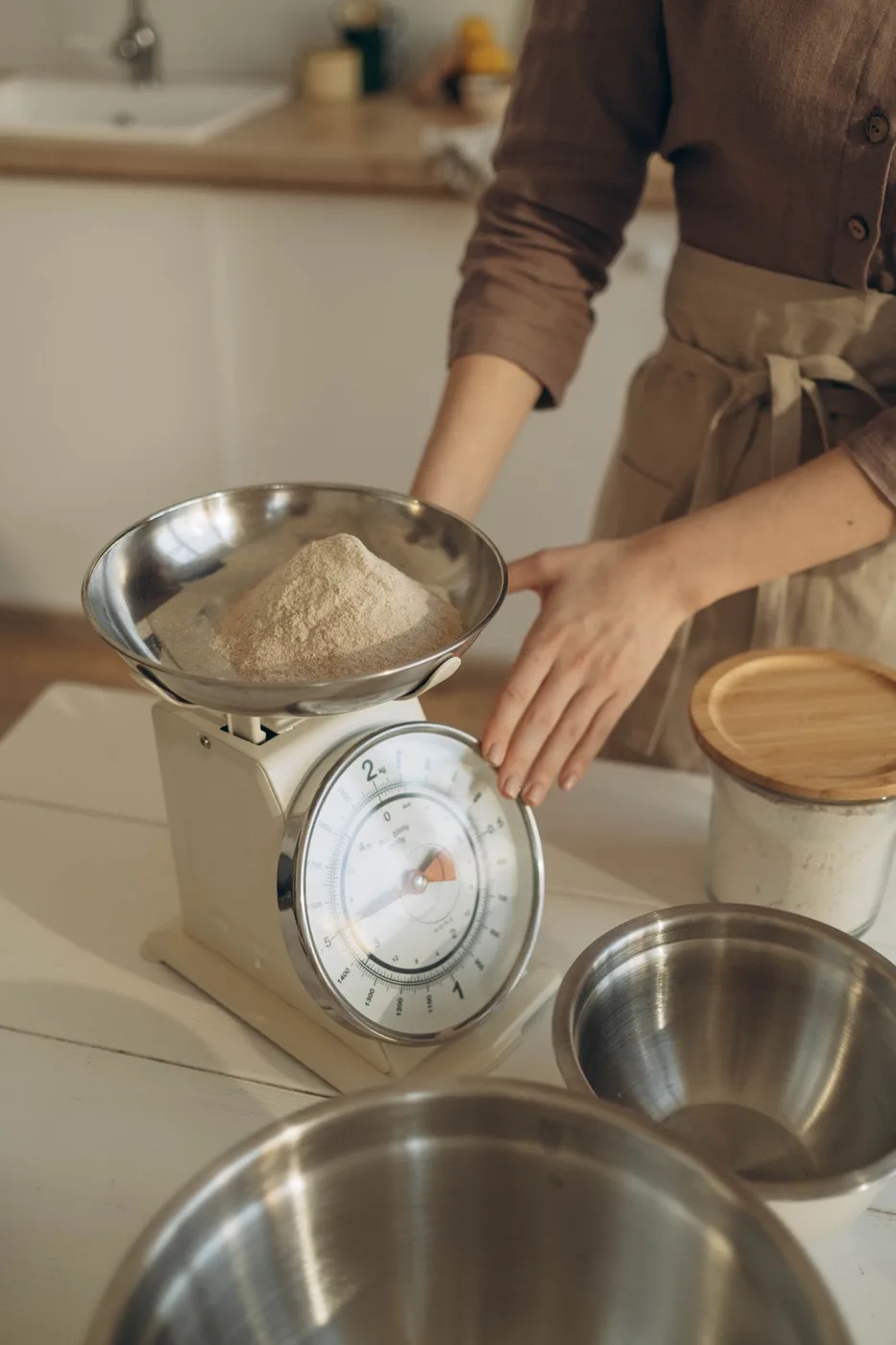
A scale's maximum capacity includes everything resting on it, even when the display has been reset to zero. A heavy ceramic bowl can use a meaningful part of the available load before you add flour or water. Weigh or look up the empty bowl and estimate your largest normal batch.
Choose some practical room above that total rather than buying an oversized scale for a hypothetical baking project. If you routinely prepare very large batches, capacity becomes more important. For small recipes, a compact platform with a readable display may be a better match for a crowded counter.
| Feature | Why it matters | What to check |
|---|---|---|
| Capacity | Includes bowl and ingredients | Your largest regular complete load |
| Display position | Large bowls can obscure readings | Visibility with your actual bowl |
| Tare or zero | Supports sequential additions | Controls and maximum total load |
| Measurement increment | Sets the displayed step size | Suitability for the smallest ingredient |
| Power behavior | Long pauses can interrupt weighing | Published timeout and power instructions |
Understand increments without assuming accuracy
A scale that displays one-gram increments is not automatically appropriate for every tiny quantity. If a recipe calls for a small fraction of a gram, the ordinary kitchen scale may not provide the required resolution. Use an appropriate method or suitable precision instrument rather than estimating from a display that cannot show the needed amount.
Displayed increments and measured accuracy are different concepts. Without independent testing, do not infer a particular error margin from the number of digits. For ordinary baking, choose a reputable product with clear specifications and instructions, then follow its operating conditions and overload limits.
Make tare a deliberate routine
Place the scale on a stable, level surface as directed, set the empty bowl on it, and zero the display. Add the first ingredient slowly as you approach its target. Record that quantity if useful, then zero again before the next addition. Keep the recipe visible so a reset does not make you forget what has already gone in.
If an ingredient can easily be overpoured, weigh it separately before adding it to the mixture. This costs one small dish but protects the batch. Avoid repeatedly taring while pouring or leaning a hand on the counter or bowl in a way that affects the load.
Look at the screen with a large bowl
OXO's 11 lb Stainless Steel Food Scale has a pull-out display, a zero function, and unit conversion according to its official page. The published increments are one gram and 0.1 ounce. A movable display is relevant if your mixing bowl otherwise hides the reading; it is not necessary for every household.
Other useful checks include button placement, legibility from your normal standing position, and whether flour can collect around controls. Review cleaning directions before choosing a finish. A removable platform may be helpful, but do not assume the entire scale can be immersed or placed in the dishwasher.
Keep the scale convenient enough to use
Choose a storage location where the scale can lie or stand in the way its maker permits, without heavy objects pressing on it. Keep suitable batteries or the correct power arrangement available. If setting up the scale requires emptying a packed drawer every time, the measuring cups will probably return.
Skip recipe databases, connectivity, or advanced modes unless you have a clear use for them. A good everyday purchase supports repeatable recipes, a visible screen, and a short cleanup. Before buying, try placing your normal bowl on a paper outline of the platform and check where the display would sit.
Shopping notes
Use these options as a starting point, then check dimensions, current materials, care instructions, availability, and the retailer’s return policy before ordering.
OXO 11 lb Stainless Steel Food Scale with Pull-Out Display
Consider it for: Home bakers whose larger bowls would otherwise hide a fixed display.
The tradeoff: Check total bowl-and-batch weight; one-gram increments do not make it a precision instrument for sub-gram quantities.
Explore at the official site External merchant link · no affiliate commissionKing Arthur Baking scale collection
Consider it for: Comparing ordinary baking scales alongside weight-based recipe resources.
The tradeoff: Match the exact model's capacity, controls, and size to your routine rather than choosing by the retailer's range alone.
Explore at the official site External merchant link · no affiliate commissionYour questions, answered
Does pressing tare restore the full capacity?
No. Tare changes the displayed baseline, while the scale still supports the bowl and all ingredients. Keep the full physical load within the manufacturer's stated maximum.
Can I replace every measuring spoon with a scale?
Not necessarily. Very small quantities may be below the useful resolution of an ordinary kitchen scale. Use the method appropriate to the recipe and the instrument's specifications.
Is a pull-out display worth paying for?
It can be when a large bowl blocks an ordinary display. If you use a small bowl and can read a fixed screen comfortably, that feature may add little to your routine.
Sources & further reading
Product and care details were checked against the sources below on October 18, 2026. Our practical recommendations are editorial judgments, and a listed source does not imply endorsement.
- King Arthur Baking: Weighing ingredientsChecked 2026-10-18
- OXO: 11 lb Stainless Steel Food ScaleChecked 2026-10-18
- King Arthur Baking: ScalesChecked 2026-10-18